
Steel Plant Shutdown reduction by 60 Hrs

The Hydraulic Exit Valve Stand-3 replacement demonstrated the use of Pyplok® non-welded cold-swage technology in high-pressure hydraulic maintenance. The work was completed in 36 hours instead of 96, recovering 60 hours of production time

Planned Shutdown

96 Hours

Actual installation and commissioning

36 Hours

Production time recovered

60 Hours

Reduction in shutdown duration

62.5%

A critical hydraulic piping replacement with only 96 hours available

The Hydraulic Exit Valve Stand-3 serves as a control hub for fluid power supplied to heavy-duty actuators, automatic gauge control cylinders and roll-balancing systems. Its piping network includes pressure lines operating up to 3,000 PSI, return/tank lines and drain lines connected to sensitive proportional valves. The existing system uses seamless ASTM A106 Grade B carbon-steel piping, which had historically required multi-pass welding and post-weld conditioning.

For this replacement, welding presented four major concerns:

Fire and explosion risk

Residual hydrocarbons inside piping can create hazards when exposed to welding temperatures exceeding 1,500°C.

Internal contamination

Welding can introduce slag, oxidation scale and spatter into the fluid system, potentially affecting precision proportional valves.

Thermal distortion

Heat input can create thermal deformation and affect pipe alignment and sealing.

Instrumentation vulnerability

Welding currents can potentially affect connected sensors, instrumentation and PLC systems.

Replacing welding with cold-swage technology

The facility replaced the conventional welded joining approach with Pyplok® non-welded radial swage technology.

Pyplok® creates a permanent mechanical connection through controlled 360° radial cold deformation, without welding heat, electrical current or chemical additives. A fitting containing internal elastomeric sealing rings is positioned over a clean, square-cut pipe. A hydraulic swaging tool then applies controlled radial force around the fitting, plastically deforming the fitting and pipe to create a mechanical interlock and compress the internal seals.
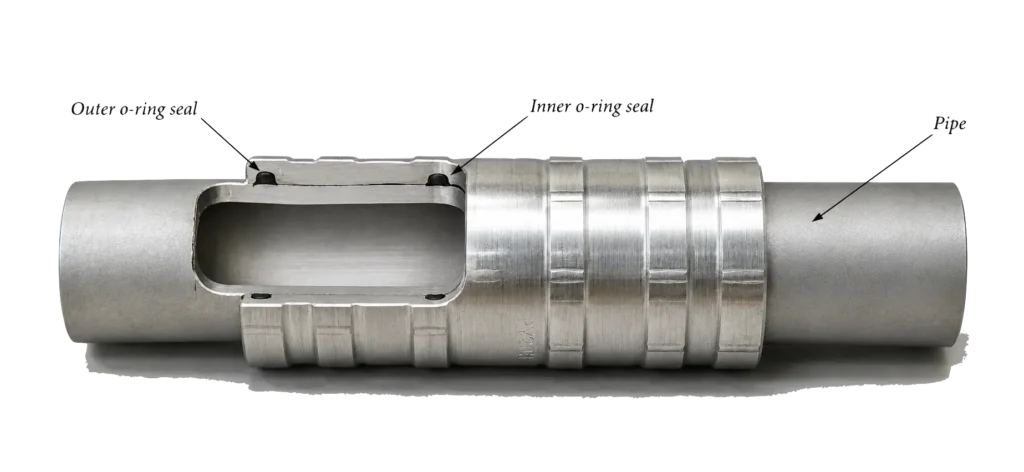
Three hydraulic power-unit series were used to accommodate the different pipe sizes across the system:

  • Model 40 — 18 mm OD drain tubing
  • Model 55 — 1/2″, 3/4″ and 1″ NPS pressure and drain circuits
  • Model 70 — 1-1/2″ NPS pressure lines and 2″ NPS return/tank lines

From Isolation to Commissioning in 36 Hours

1. Isolation & Extraction — Hours 0–8

The high-pressure systems were depressurised and standard safety lockouts were applied. The existing valve stand was mechanically disconnected and removed from the operational area.

2. Piping Preparation & Positioning — Hours 8–20

The new Valve Stand-3 was structurally anchored. The ASTM A106 pipes were measured and cut square using cold-cutting orbital saws, followed by deburring to ensure clean insertion depths.

3. Swaging Sequence — Hours 20–30

The Model 40, 55 and 70 hydraulic tool series were used to complete the required swaged connections. Each joint was checked using a “Go-No-Go” inspection gauge to verify the correct mechanical crimp.

4. Testing & Commissioning — Hours 30–36

Instrumentation loops were connected and the hydraulic circuit underwent hydrostatic testing at 1.5× the operating threshold. No weeping or micro-leaks were detected, and Stand-3 was subsequently handed over to production.

60 Hours of Production Time Recovered

The biggest outcome was the reduction in the shutdown period.

The complete replacement and commissioning took 36 hours instead of the allocated 96 hours, returning the equipment to production 60 hours earlier than planned. This represents a 62.5% reduction in the allocated shutdown duration.

Beyond the time saving, the cold-work approach also addressed the technical risks associated with welding. No welding heat, sparks or electrical arc were introduced; no welding-related slag, scale or spatter was generated; and the installation avoided thermal distortion. The project also maintained the integrity of connected instrumentation and used immediate mechanical gauge verification for joint quality.

Why Cold-Swage Technology Was Better Suited to This Application

Parameters

Traditional Welding

Pyplok

Joining mechanism

Thermal fusion

Mechanical radial deformation

Heat input

High

None

Internal Contamination

Risk of slag/scale/spatter

No welding contamination

Post-join flushing

Required

Simplified

Quality verification

NDT requirements

Go-No-Go gauge

Execution window

96 hours

36 hours

Faster Maintenance. Lower Risk. Earlier Production Restart.

The Hydraulic Exit Valve Stand-3 replacement demonstrated how non-welded piping technology can reduce both maintenance downtime and the risks associated with conventional hot-work installation in a continuous-process manufacturing environment. The project was completed in 36 hours, recovering 60 hours of production time, while avoiding welding-related heat, contamination and electrical risks. The successful installation and pressure testing provided the facility with a practical alternative for future high-pressure fluid-power modifications. According to the case study, the plant engineering team subsequently validated cold-swage technology as the primary standard for future high-pressure fluid-power modifications.

Talk to our engineering team about your piping requirements and find the right solution for your application.

Also read

Send Enquiry

Kindly provide your details and project requirements, and our team will promptly get in touch with you to address your needs. We look forward to assisting you!