

Eliminating Hot Work in a Marine Hydraulic Piping Retrofit

Mubarak Marine, Dubai, undertook the modernisation of the hydraulic piping connecting Thrustmaster thruster units to deck-mounted hydraulic power packs. The system needed to withstand high cyclic pressures, mechanical vibration and demanding marine conditions. Traditional welded piping introduced hot-work requirements, inspection requirements and the risk of internal contamination. The retrofit therefore adopted a zero-welding approach for the structural hydraulic runs between the thruster wells and deck infrastructure.

Hot-Work-Free

100%

Faster Commissioning

45%

Challenge : Conventional Welding Created Multiple Constraints

Marine hydraulic piping presents challenges that go beyond simply creating a pressure-tight connection. The thruster hydraulic circuits operate under intense cyclic pressures and significant mechanical vibration, while the confined spaces around the thruster units make hot work particularly demanding.

Traditional welded piping introduced several additional requirements:

Hot-work permits, fire watches and gas-free certification

Continuous monitoring during welding operations

Radiographic or dye-penetrant inspection

Internal mill scale, slag and oxidation

Chemical acid pickling to restore internal cleanliness

Heat-affected zones and associated fatigue concerns

Additional time before hydraulic systems could be flushed and commissioned

The Engineering Requirement

The project therefore required a piping solution that could provide:

High-pressure integrity + vibration resistance + internal cleanliness + rapid installation — without welding.

Solution : A Complete Non-Welded Hydraulic Piping System

Rather than relying on a single connection technology, the piping system was engineered using three complementary Tube-Mac technologies, selected according to pipe size, pressure requirements and available installation space.
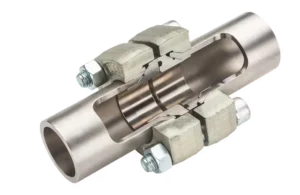
01 — TMI 37° Flare Flanges

Used on medium-to-large high-pressure feed lines from ½” to 2″ nominal pipe.

Pipe ends were mechanically cold-flared to a 37° profile using portable hydraulic tooling. An internal cone with elastomeric O-ring sealing was then assembled into a leak-tight mechanical connection rated up to 420 bar (6,000 PSI).

02 — TMI Retain Ring Flanges

Used on larger-bore, heavy-wall piping from 2″ to 4″ and above, including low-pressure return and high-volume suction lines.

A precision-machined groove on the pipe accommodated a heavy-duty split retain ring, creating a mechanical shoulder for the sliding flange while maintaining the pipe’s full wall thickness without heat exposure.

03 — PYPLOK®  Fittings

Used for small-bore control loops, instrumentation and pilot lines, particularly in compact spaces around the Thrustmaster valve blocks.

The fittings were cold-swaged onto the pipe using specialised hydraulic pressing equipment, creating a permanent, maintenance-free connection without introducing heat into the piping.


Installation Without Welding

One of the major advantages of the approach was that the specialised preparation equipment could be brought directly to the work location.

The piping could therefore be prepared and assembled in situ, without removing sections for off-site fabrication or obtaining hot-work authorisations.

Cold Flare

Pipes were cut, deburred and mechanically flared directly within the thruster space using compact electro-hydraulic flaring equipment.

Grooving & Retain Rings

Portable high-torque grooving tools created the required external profiles on larger-diameter return piping without heat input or alteration of the pipe’s structural metallurgy.

PYPLOK® Swaging

Each PYPLOK® fitting was pressed using specialised hydraulic tooling and subsequently checked with a Go/No-Go inspection gauge, providing immediate verification of the connection.

Result : A Faster, Cleaner and Safer Hydraulic Integration

The completed installation demonstrated the practical advantages of replacing welded hydraulic connections with cold-formed mechanical technologies. The hydraulic integration was 100% hot-work-free, eliminating associated permits and safety controls, while flushing and commissioning timelines were reduced by more than 45% compared with welded configurations. The TMI 37° Flare Flange system provides a maximum rated pressure of 420 bar (6,000 PSI), and hydrostatic testing recorded zero pressure drops or weeping across the mechanical connections..

From Welding-Dependent Installation to Cold-Formed Assembly

The project demonstrated that high-performance marine hydraulic piping does not necessarily require conventional welded construction.

By combining 37° Flare Flanges, Retain Ring Flanges and PYPLOK® Permanent Press Fittings, the installation eliminated hot work while addressing three critical requirements of marine hydraulic systems:

Safety

No hot-work operations across the hydraulic integration.

Cleanliness

No welding slag or oxidation introduced into the hydraulic circuit.

Speed

More than 45% reduction in flushing and commissioning timelines.

Reliability

Leak-free mechanical connections that withstand demanding pressure and vibration conditions.

Conclusion: A Practical Blueprint for Marine Hydraulic Retrofits

The Mubarak Marine project demonstrates how non-welded piping technologies can transform hydraulic system installation in demanding marine environments.

By removing hot work, reducing contamination risks and accelerating commissioning, the approach provides a practical alternative for marine propulsion systems, vessel retrofits and new-build hydraulic installations.

Talk to our engineering team about your piping requirements and find the right solution for your application.

Also read

Send Enquiry

Kindly provide your details and project requirements, and our team will promptly get in touch with you to address your needs. We look forward to assisting you!