


To overcome the limitations of conventional welding, Cenergy Offshore used PYPLOK® non-welded compression fittings for the high-pressure stainless-steel tubing network.
The PYPLOK® cold-swage process uses portable hydraulic tooling to compress the fitting directly onto the tubing, creating a permanent mechanical seal without heat or purging and without the post-installation NDT requirements associated with welded joints described in the case study.
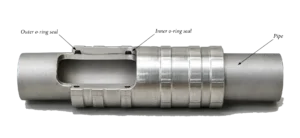
1. Preparation
The stainless-steel tube is cut, deburred and marked to establish the required insertion depth.
2. Positioning
The PYPLOK® fitting is positioned onto the tube up to the marked depth.
3. Swaging
A portable hydraulic tool compresses the fitting onto the tubing to create the joint.
4. Inspection
The completed connection is immediately verified using a Go/No-Go gauge.
This simplified workflow enabled trained operatives to complete and verify connections in minutes while avoiding the specialised welding certification, hot-work permits and post-installation radiography associated with the conventional approach described in the case study.
The project team successfully installed approximately 20 km of 22 mm stainless-steel tubing, incorporating around 4,000 PYPLOK® fittings, at a sustained installation rate of more than 350 metres per day. The complete high-pressure fire suppression network was built, inspected and commissioned in less than eight weeks, while successfully passing a 180-bar hydrostatic pressure test to validate its readiness for 120-bar operating pressure.
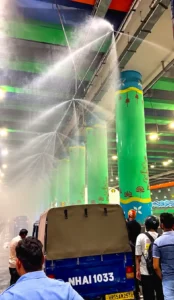
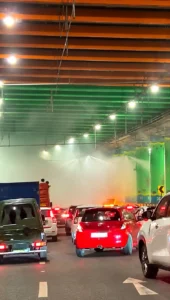
In July 2026, a vehicle fire occurred inside the Dwarka Expressway Tunnel, generating thick smoke and trapping nearby motorists. The tunnel’s automated fire detection system responded by activating the high-pressure water mist system, which rapidly discharged water mist to provide localised cooling and contain the fire before emergency crews arrived.
During the incident, the installed high-pressure piping network was subjected to the resulting hydraulic pressure event. The PYPLOK® fittings maintained their structural seal integrity, with no joint failure reported.
 .
.  .
. 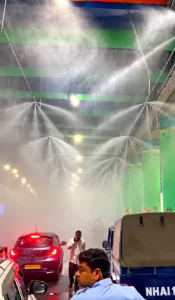
The incident provided a valuable real-world validation of the piping system’s performance under actual fire-response conditions, demonstrating that the non-welded PYPLOK® connections maintained their integrity while the fire suppression system was operating under pressure. This performance reinforces the reliability of the installed network for critical tunnel fire protection applications.