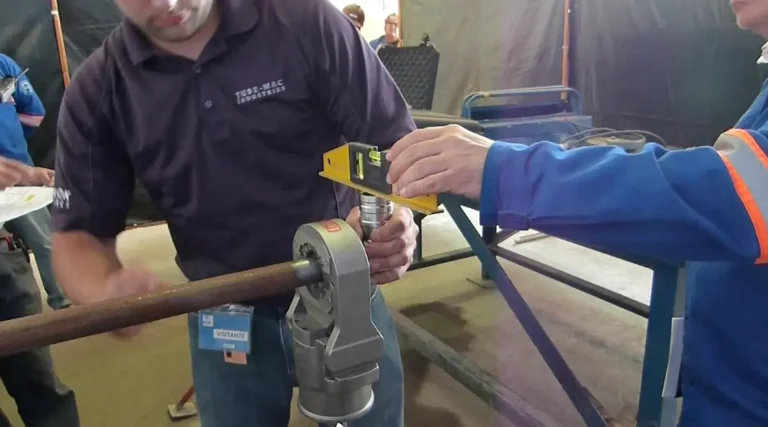
Traditional welded piping requires multiple fabrication and inspection activities, including joint preparation, fit-up, tack welding, welding, visual inspection and dye penetrant testing. These activities can increase fabrication time, manpower requirements and the duration of piping installation. Pyplok® is a mechanically attached, cold-work piping connection system that uses a hydraulically powered tool to radially swage a fitting onto the pipe. The connection is made without welding or heat generation. The system is designed for a range of piping applications where cold connection technology can provide advantages in installation speed, safety and accessibility.
A comparative study conducted by ALUSA Engineering evaluated Pyplok® against conventional welded piping using two lines with the same material, diameter, number of joints and spool geometry. Both spools were prepared and assembled under the same conditions and by the same team to minimize the influence of human factors.
In the study:
| Conventional Welding | Pyplok® | |
|---|---|---|
|
No of Joints |
12 |
12 |
|
Total execution time |
231 min |
98 min |
|
Average time per joint |
19.25 min |
8.2 min |
|
Total Fabrication Cost |
R$ 10,217.28 |
R$ 4,284.72 |
the reported execution time was therefore approximately 59% lower for Pyplok® in this particular test, while the reported fabrication cost was approximately 58% lower.
What is Pyplok®?
Pyplok® is a 360° radial swage mechanically attached fitting designed to permanently connect pipe and tube without welding. A hydraulically powered compression tool swages the fitting onto the pipe, creating a mechanically retained and sealed connection.The fitting incorporates O-ring sealing elements. The document describes an inner main seal for high-pressure sealing and an outer environmental seal intended to prevent the ingress of fluids and contaminants between the fitting and tube.The connection is made using a cold-work process, eliminating the heat generated by conventional welding.
Key characteristics
1. Non-welded cold connection
2. No heat generation during installation
3. Hydraulically powered installation tool
4. 360° radial swaging
5. Permanent mechanical connection
6. O-ring sealing
7. Suitable for a range of industrial piping applications
8. Available in carbon steel, stainless steel, Cu-Ni, Duplex and Super Duplex
Steps in Joining Pipes
| Conventional Welding Connection | Pyplok |
|---|---|
|
|
Pyplok® is a 360° radial swage mechanically attached fitting designed to permanently connect pipe and tube without welding. A hydraulically powered compression tool swages the fitting onto the pipe, creating a mechanically retained and sealed connection.The fitting incorporates O-ring sealing elements. The document describes an inner main seal for high-pressure sealing and an outer environmental seal intended to prevent the ingress of fluids and contaminants between the fitting and tube.The connection is made using a cold-work process, eliminating the heat generated by conventional welding.
Key characteristics
Non-welded cold connection
No heat generation during installation
Hydraulically powered installation tool
360° radial swaging
Permanent mechanical connection
O-ring sealing
Suitable for a range of industrial piping applications
Available in carbon steel, stainless steel, Cu-Ni, Duplex and Super Duplex
Design Conditions
| Parameter | Test Condition |
|---|---|
|
Application |
Boiler water for steam generation |
|
Design Temperature |
223° C |
|
Design Pressure |
15.1 kg/cm² (14.8 bar) |
|
Hydrostatic Test Pressure |
23.1 kg/cm² (31.5 bar) |
|
Insulation |
38mm |
|
Operating Temperature |
193° C |
|
Operating Pressure |
12.6 kg/cm² (12.4 bar) |
Installation Time Comparison
| Fabrication Activity | Welding | Pyplok® |
|---|---|---|
| Pipe preparation, cutting plan & connection cleaning | 75 min | 60 min |
| Pyplok® fitting compression | — | 38 min |
| Coupling using ER welding process | 105 min | — |
| Welding connections | 21 min | — |
| Visual inspection | 15 min | — |
| Dye penetrant inspection | 15 min | — |
| Dimensional inspection | Equal | Equal |
| Hydrostatic testing | Equal | Equal |
| Total execution time | 231 min | 98 min |
| Number of joints | 12 | 12 |
| Average time/joint | 19.25 min | 8.2 min |
The study reported 231 minutes for conventional welding compared with 98 minutes for Pyplok®, resulting in a reduction of approximately 133 minutes for the 12-joint spool.What this means
For the particular test:
Welding: 19.25 minutes/joint
Pyplok®: 8.2 minutes/joint
That represents approximately 2.35× faster execution per joint in the test.
Fabrication Cost Comparison
| Fabrication Phase | Welding Cost (R$) | Pyplok® Cost (R$) |
|---|---|---|
| Pipe preparation, cutting plan & cleaning | 2,751.00 | 2,200.80 |
| Pyplok® compression | — | 1,393.84 |
| Pyplok® operator | — | 690.08 |
| Coupling using ER welding | 3,851.40 | — |
| Welder – coupling | 2,339.40 | — |
| Welding connections | 467.88 | — |
| Visual inspection | 403.8 | — |
| Dye penetrant inspection | 403.8 | — |
| Total | 10,217.28 | 4,284.72 |
Reported Result
| Metric | Result |
|---|---|
| Welding fabrication cost | R$10,217.28 |
| Pyplok® fabrication cost | R$4,284.72 |
| Difference | R$5,932.56 |
| Approx. reduction | 58.10% |
The study reported a total fabrication cost of R $10,217.28 for the welded system compared with R$ 4,284.72 for Pyplok®.
Manpower and Process Requirements
| Welding requires | Pyplok requires |
|---|---|
|
|
The study therefore identifies the elimination of welding and weld inspection stages as one of the significant contributors to the reduction in execution time and cost
Testing and Leak Performance
The ALUSA test lines were subjected to a hydrostatic test at 23.1 kg/cm² (31.5 bar) without leaks. A separate bench test using the same material as the spool was performed at 250 kg/cm², with no leaks reported. A pneumatic test was also performed on the Pyplok® spool, with no leaks detected.
The Portuguese version of the original report provides the same test information and identifies the test line and material specifications.
Key Advantages Identified in the Study
No Hot Work
Pyplok® is installed using a cold compression process and does not generate welding heat during installation. The source document specifically identifies this as advantageous in flammable environments such as refineries.
Faster Installation
The ALUSA comparison recorded 98 minutes vs 231 minutes for 12 joints.
Reduced fabrication activities
Welding, visual weld inspection and dye penetrant inspection were eliminated from the Pyplok® process examined in the study.
Lower reported fabrication cost
The ALUSA study recorded a fabrication cost of R$ 4,284.72 vs R$ 10,217.28.
Reduced shutdown time potential
The document identifies rapid installation as a means of reducing shutdown duration.
Portable installation equipment
The study identifies portability of the equipment as an advantage.
Where Pyplok® Can Provide Value
The document identifies applications across industries including: Marine & Offshore Navy Oil & Gas Petrochemical Steel Mining Industrial applicationsIt also describes applications involving gases, oil, compressed air and steam, subject to the applicable system limitations and specifications.
Conclusion
The comparative ALUSA study demonstrates the potential of Pyplok® to significantly reduce the time and fabrication activities associated with small-diameter piping connections when compared with conventional welding.
For the 12-joint spool evaluated: 231 minutes vs 98 minutes and: R$10,217 vs R$4,285
The study therefore demonstrated approximately 59% lower fabrication time and approximately 58% lower fabrication cost under its specific test conditions.
Beyond fabrication time and cost, the cold-work nature of Pyplok® eliminates welding heat and removes several welding-related activities from the installation sequence. This can be particularly relevant for applications where hot work, shutdown duration, accessibility or rapid installation are important considerations.
Pyplok® should not be viewed simply as another pipe fitting. It represents an alternative connection method that can change the way certain piping systems are fabricated, installed and maintained.